El Niño Benchmark Ocean Temperatures Hit All-Time Record High, Stoking Global Climate Concerns
Key Points
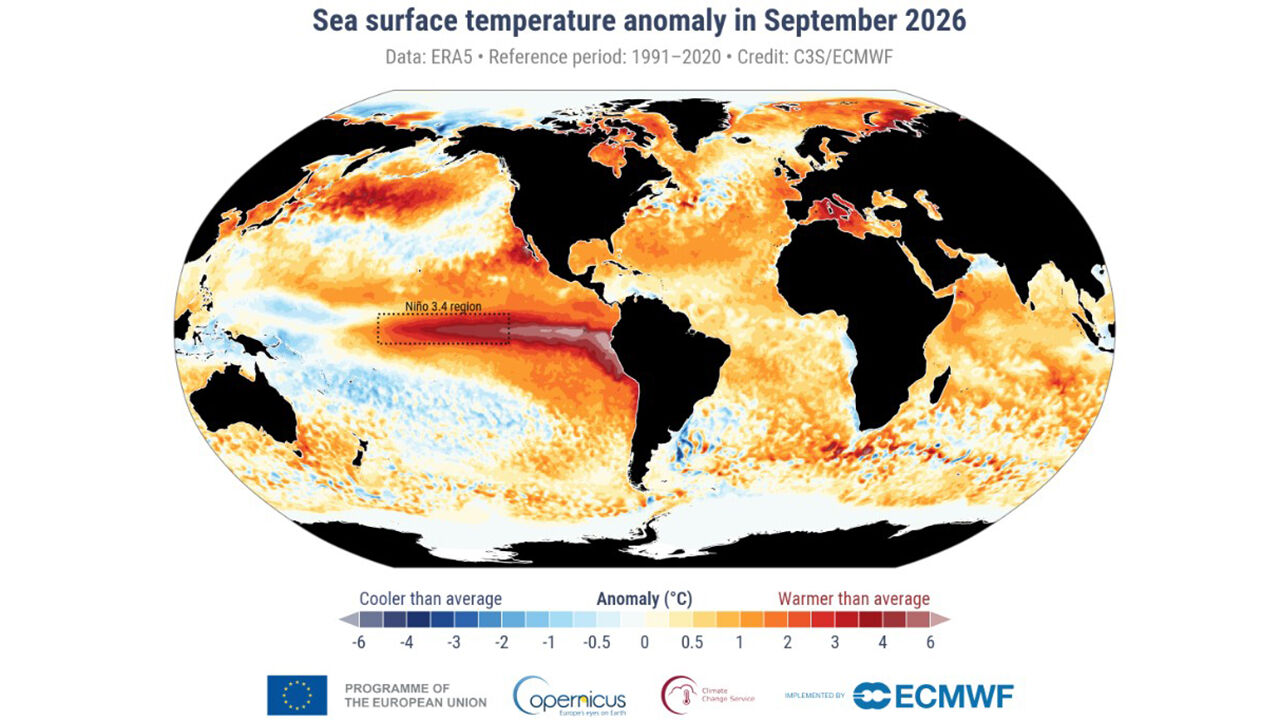
- Average sea surface temperatures in the equatorial Pacific 'Niño 3.4' zone reached a record 29.70°C in September 2026, surpassing historical peaks of past major El Niño cycles.
- The spike is drawing intense attention in South Korea and globally as meteorological agencies report unprecedented temperature anomalies of up to +4.0°C above historical norms.
- Experts warn that because this powerful El Niño has not yet peaked, global average temperatures could break all-time records again in 2027.
Summary Global climate monitoring agencies have sounded fresh alarms as sea surface temperatures in the key equatorial Pacific benchmark zone reached an unprecedented high last month. According to data released by the European Union's Copernicus Climate Change Service (C3S) and reported by international news wire AFP, the average sea surface temperature in the critical 'Niño 3.4' region—spanning 5°S to 5°N and 170°W to 120°W—hit 29.70 degrees Celsius in September 2026. This reading marks the highest sea surface temperature ever recorded in the zone, eclipsing historical monthly peaks witnessed during notorious super El Niño events such as those in 1982–1983, 1997–1998, and 2015–2016.
The extraordinary spike underscores the intensity of the ongoing El Niño phenomenon, a naturally occurring climate pattern typically recurring every two to seven years and lasting roughly nine to twelve months. However, scientists caution that declaring the current episode the strongest in history remains nuanced. Because overarching climate change has steadily driven ocean baselines higher, recent El Niño cycles may appear more extreme in raw temperature terms without necessarily having larger anomalies relative to contemporary baselines. Meteorologists measure El Niño intensity through 'anomalies'—the deviation from multi-decade historical averages (currently standard 1991–2020 means)—rather than raw surface readings alone. Under C3S's updated indices accounting for broader tropical ocean warming, the current event is extraordinarily strong though perhaps not the absolute record-holder by that metric.
Nevertheless, regional agencies reflect growing concern over the unprecedented pace of warming. The Japan Meteorological Agency recently observed that its own index logged an ocean temperature anomaly of +4.0 degrees Celsius in the Niño 3.4 zone last month, the highest since records began in 1949 and surpassing the previous record of +3.6 degrees set in December 1997. Across the broader globe, the worldwide average sea surface temperature reached a record 21.05 degrees Celsius, while global mean surface air temperatures marked the second warmest on record at 16.27 degrees Celsius (+1.63 degrees above pre-industrial levels). With this powerful El Niño yet to reach its anticipated peak, climate scientists warn that 2027 could see global temperature records shatter once again.
Sponsored · Ad