France's 5,400 Trillion Won Debt Dilemma: Why Escalating Protests Leave Paris With No Easy Way Out
Key Points
- Massive student and labor demonstrations have erupted across France demanding increased welfare and public spending, directly clashing with government austerity plans.
- Korean media and audiences are closely analyzing France's fiscal crisis, contrasting its 5,400 trillion won debt burden and civil service costs with Korea's own fiscal and corporate tax realities.
- Caught between OECD-topping tax burdens, an upcoming presidential election, and President Macron's 15% approval rating, the French government faces a profound political and economic paralysis.
Summary A recent commentary by SBS reporter Kwon Young-in has drawn widespread attention in South Korea, dissecting why the ongoing protests and riots sweeping France represent an almost insurmountable financial and political dilemma. Broadcast across global news networks, shocking scenes of mass demonstrations and looting in French cities have piqued the curiosity of Korean observers, who often compare foreign economic policies and fiscal discipline with their own national realities.
At the core of the issue is a staggering fiscal imbalance: France is facing an astronomical national debt of approximately 5,400 trillion won (nearing 120% of its GDP), with annual interest payments alone projected to exceed 100 trillion won. For the upcoming fiscal year, projected government revenues stand around 563.5 trillion won—mostly from taxes—while planned spending exceeds 823.3 trillion won, leaving a gaping projected deficit of roughly 235 trillion won that must be funded through government bonds. To stave off a sovereign debt crisis, the French administration has sought to cut spending by around 37 trillion won, acknowledging that France’s tax burden is already among the highest in the OECD and that the country lacks corporate cash cows—like South Korea's tech titans Samsung Electronics or SK Hynix—capable of rapidly replenishing national coffers.
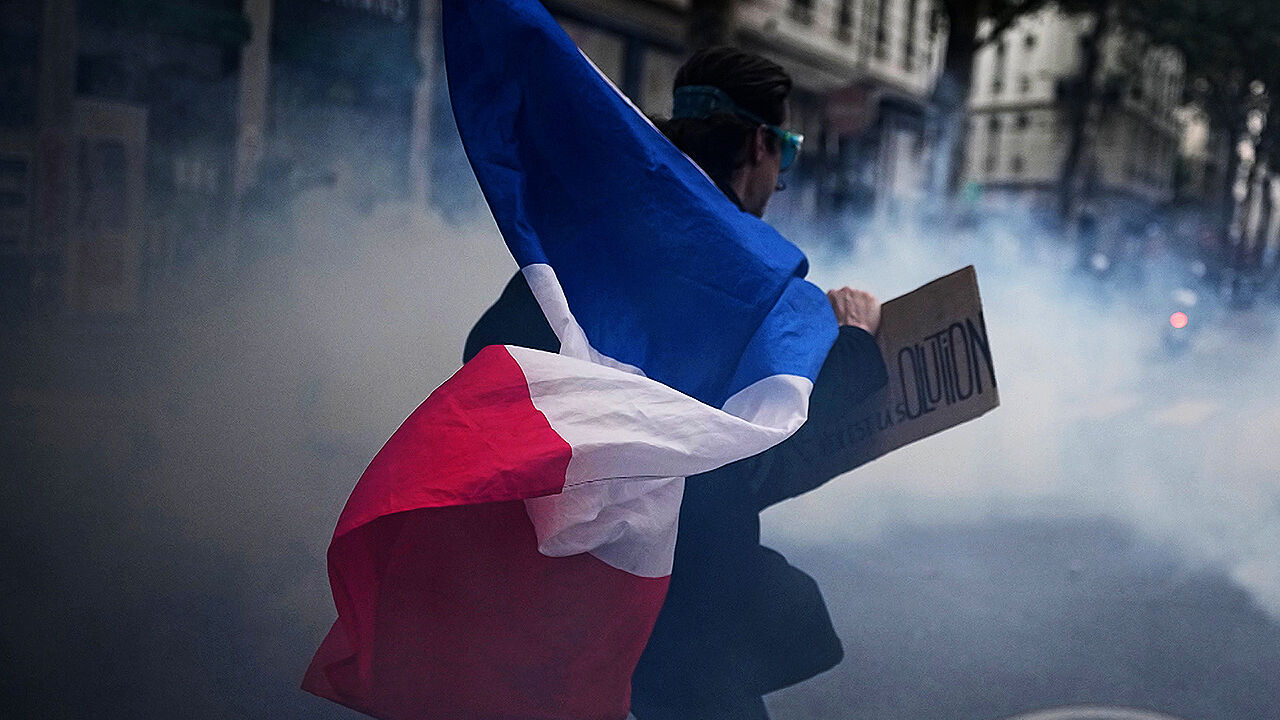
However, French protesters, led by student unions and organized labor, are demanding precisely the opposite: a massive increase in public spending. Students are calling for 15 trillion won to fix deteriorating school facilities and hire teachers, dismissing the government's offer of 1.5 trillion won annually as wholly inadequate and threatening continued blockades. Meanwhile, labor unions demand extensive wage hikes for civil servants, a 10% raise that alone would cost 35 trillion won, pointing out that France employs twice as many public servants proportionally as South Korea. Demonstrators argue that funds should not be cut from public welfare but extracted from big corporations and ultra-wealthy individuals via measures like the proposed "Zucman tax" on fortunes over 100 million euros, as well as hefty penalties on American tech giants like Apple, Google, Meta, and Amazon.
Compounding this economic standoff is a severe leadership void. With French President Emmanuel Macron's approval rating hovering around a dismal 15% and a pivotal presidential election looming in April where hard-line candidates lead the polls, the administration lacks the political leverage to broker any lasting social consensus. As Korean commentators observe, the crisis reflects a paralyzed political ecosystem where neither fiscal austerity nor populist spending demands can easily prevail.
Sponsored · Ad